
This week, I’m chatting with indie dystopian author Charley Mayne about the Booktok Indie Author Awards finalist, Bonds of Slavery.
Charley Mayne is an Irish indie author of dark dystopian fiction and the creator of The Chainmark Series, a character-driven exploration of survival, identity, resilience, and the human cost of power.
At the heart of the series is Ryan Murphy, a sixteen-year-old boy navigating a world where slavery has become legal and freedom comes at a price. Through his story, Charley explores the uncomfortable spaces between obedience and surrender, cruelty and compassion, and survival and hope.
Known for emotionally challenging narratives and morally complex characters, Charley doesn't shy away from difficult subjects or the questions they raise.
When she's not writing, she can usually be found walking the Irish coastline, collecting seashells, or causing a little chaos on BookTok.
Tell us about your book. What is it about, and what makes it special?
Bonds of Slavery is the first book in The Chainmark Series, a dark dystopian story set in America in 2045, where overcrowded prisons and a ruthless government have given rise to the Chainmark Act, legislation that allows convicted prisoners to be sold into legal slavery.
At sixteen, Ryan Murphy is arrested, convicted and sold to Brad Wilkins, a man who believes obedience is absolute and cruelty is justified.
What follows is not simply a story about captivity. It's about what happens when someone has the power to control every aspect of another person's existence, and how much of yourself you can lose before you stop recognising who you are.
Ryan isn't a conventional hero. He's frightened, angry, stubborn and sometimes makes terrible decisions. He doesn't always win. Sometimes he doesn't even fight. Sometimes surviving another day is the only victory available to him.
But beneath everything he endures is a determination to remain Ryan Murphy.
I think what makes the story special is that it doesn't offer easy answers. It explores the uncomfortable distinction between obedience and surrender, the people who choose cruelty, those who look away, and the few who find the courage to care.
Ultimately, Bonds of Slavery is about survival, identity and the stubborn persistence of hope, even in a world designed to extinguish it.
And it's only the beginning of Ryan's story.
What first inspired you to write this story?
The story actually began on a beach. I'd finished reading my book and decided to try writing something of my own. I always carry a pen and notebook, so that's exactly what I did. The first three chapters of Bonds of Slavery were written in that tiny notebook.
As for why I chose this particular story, I think it comes down to who I've always been.
I've spent much of my life pushing back against people who tried to control me, particularly when I was a teenager. I've always been determined to be myself, even when the cost of refusing to bend was high.
And I suppose that's what Ryan's story is really about. Survival, yes, but also identity. The determination to hold on to who you are when someone else is doing everything in their power to take that away.
Ryan's circumstances are fictional, but that fight to remain yourself is something I understand.
What kind of reader do you think would fall in love with this book?
I'm not sure 'fall in love' is quite the right phrase for a book that regularly leaves readers threatening to throw their Kindles across the room!
But if you enjoy dark, character-driven fiction that challenges you emotionally and makes you question the world around you, Bonds of Slavery might be for you.
It's for readers who aren't afraid of uncomfortable subjects, who appreciate morally complex characters, and who understand that survival doesn't always look heroic.
It's not an easy read, and I wouldn't pretend otherwise. But if you're the kind of reader who becomes fiercely protective of fictional characters, gets irrationally angry at villains, and carries a story with you long after you've finished it, there's a good chance Ryan Murphy will get under your skin.
What do you hope readers will still be thinking about after finishing the book?
I'd like readers to think about how easily we can lose sight of someone's humanity when society decides they're somehow less deserving of it.
The Chainmark Act makes slavery legal, but it doesn't make it right. And throughout Ryan's story, there are people who use the law to justify their cruelty, others who turn a blind eye, and a handful who recognise that being legally owned doesn't make someone any less human.
I'd also like readers to question what they might do in that world. Would they speak up? Would they look away? Would they convince themselves there was nothing they could do?
But more than anything, I hope they remember Ryan. Not simply for what he endured, but for who he fought so hard to remain.
What's the hardest decision a character in your book has to make?
Poor Ryan. Sometimes I think his moral compass is his biggest problem. Throughout the series, he's constantly forced to choose between doing what he's told and doing what he believes is right. Ryan has been taught that obedience means survival. Disobedience brings punishment, and he knows that better than anyone. But here's the problem. Ryan is fundamentally a good kid. If he sees someone suffering, he struggles to walk away. If someone needs help, he'll risk getting involved. And if an order goes against everything his Nonna taught him about right and wrong, there's a very good chance he'll refuse to follow it. Even when he knows exactly what that refusal will cost him. I think that's one of the cruelest things about Ryan's situation. The qualities that make him a decent human being are often the very things that make his life as a slave so much harder. And sometimes there isn't a right decision. Helping someone else might mean putting himself in danger. Obeying might mean allowing something terrible to happen. He's sixteen when his story begins. He shouldn't have to make those choices at all. But he does. And I think that's what makes Ryan who he is. Not that he always makes the right decision, because he doesn't. Not that he's fearless, because he's certainly not. It's that, despite everything, he keeps trying to be the person his Nonna raised him to be. If Ryan were a little less compassionate, a little more selfish, and a lot more willing to look the other way, he'd probably have had a much easier time in slavery. But he wouldn't be Ryan.
Which character most desperately needs a hug. And would they accept one?
Ryan Murphy. Without question. And yes, he would accept one. But it's complicated. After spending so long being treated as property, Ryan has learned that physical contact rarely means anything good. His instinct would probably be to step away, even from someone he trusts. There's a scene in The Run where Mrs. Byrne wraps her arms around him. He freezes, but inside he's desperate to return the hug. He actually looks to another man for permission before allowing himself to put his arms around her. For a few moments, he closes his eyes and pretends she's his Nonna. And when the hug ends, he immediately feels the loss. What breaks my heart about that scene is what happens afterwards. Ryan nearly has a panic attack, not because someone has hurt him, but because someone has shown him kindness. That's the thing about Ryan. He desperately needs affection, reassurance and human connection, but he's spent so long being denied those things that receiving them can be overwhelming. So yes, he'd accept a hug. But he'd need to know it was safe to hold on.
Is there a character who surprised you by becoming more important than you originally planned?
Nonna Lucia. Without a doubt. The funny thing is, she was almost an accident. I write some very dark subject matter, and I realised early on that if Ryan was going to survive everything I intended to put him through, he needed something to draw strength from. I'm a method writer, which can be incredibly difficult when you're writing scenes like these. I try to put myself in my characters' situations and understand how they might think, feel and survive. During one of the first traumatic scenes I wrote, I found myself wondering how I would get through something like that. And suddenly, I heard my own Nonna's voice in my head. It wasn't planned. I simply wrote what I heard. Then she kept appearing. Whenever Ryan was frightened, overwhelmed or close to breaking, there she was again. So I lent Ryan my Nonna. Her voice, her wisdom, her love, and the strength she gave me. And somewhere along the way, she became one of the most important characters in the entire series. She's rarely physically present, but she's always with him. When he can't find the strength to keep going, he reaches for her voice. When he's losing sight of who he is, she reminds him. I genuinely believe she's one of the main reasons Ryan has managed to remain so strong. She wasn't part of the plan. But I can't imagine his story without her.
Which scene was your favourite to write, and which was the hardest?
The hardest scene to write was Chapter Four, The Yard, in Bonds of Slavery. I rewrote it because the first version simply wasn't good enough. I knew what I wanted the chapter to convey, but getting it right was incredibly difficult. It's still one of the hardest chapters for me to revisit. Another was The Edge in The Vanishing. I'd spent three books writing this beautiful, stubborn boy who kept finding reasons to survive, no matter what was thrown at him. Writing the moment when Ryan finally gave up, when he decided he simply couldn't take any more, was heartbreaking. But my favourite scene to write was Tack, in Bonds of Slavery. Not because it's a happy chapter. It isn't. Ryan is desperately close to breaking point. But Jake shows up for him. One kid, without being asked, sits beside him and listens. For over a year, Ryan has been silenced by the man who owns him. Suddenly, he has the freedom to tell someone what's happening to him. To speak without permission. To be heard. And the relief that brings him is enormous. I love that scene because it reminds me that sometimes all it takes to pull someone back from the edge is one person showing up. That's something I try to carry into my own life. I aspire to be the person who shows up when a friend needs me. No questions asked.
Are you a meticulous planner, a discovery writer, or somewhere in between?
Oh, I'm an absolutely brilliant planner. It's the sticking to the plan that seems to be the problem! I have an engineering background, so my brain works a little differently. I always write the last chapter first. I need to know exactly where the story ends, and then I reverse-engineer how my characters get there. I'll map out chapters, plan scenes, and convince myself I've got everything organised. And then I start writing. That's when the rabbit holes appear. A character will say something unexpected, make a decision I hadn't anticipated, or introduce a completely new direction. I call these deviations my rabbit holes, and I've learned that some of the best moments in my books come from following them. Sometimes those rabbit holes lead to entire chapters I never intended to write. So I suppose I'm a discovery writer with an engineer's brain. I know exactly where I'm going, but the journey there is rarely straightforward. The destination is fixed. The route is negotiable.
Discover Bonds of Slavery
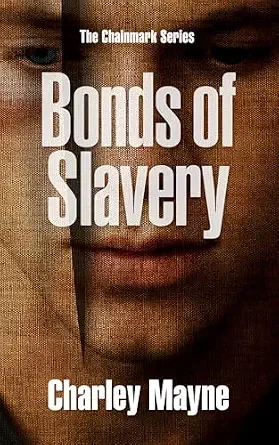
Ryan’s Story Begins.
OBEDIENCE IS SURVIVAL
RESISTANCE IS PAIN
In a future where freedom has a price, how far would you go to survive?
The year is 2045. America’s war on drugs has become a war on its own people. Overcrowded prisons and a ruthless administration give rise to the Chainmark Act: a dystopian solution to mass incarceration, cloaked as justice.
Ryan Murphy, sixteen and already hardened by life on the streets of New York, becomes one of the first minors “offered” into the system. Sentenced for a crime he didn’t fully understand, he’s sold to Brad Wilkins—a sadistic Texas rancher who sees obedience as the only law.
As Ryan grapples with trauma, isolation, and control, he must learn the rules of survival inside a world designed to erase him. But even in the darkest corners of captivity, hope flickers—because Ryan knows that surviving isn’t enough.
He wants to live.
And he wants to be free.
A brutal, unflinching coming-of-age story for fans of dark fiction, dystopian drama, and psychological survival. Book One in the Chainmark Series.
Want to be featured?
Are you an indie fantasy or sci-fi author? Find out how to be featured in a future Indie Author Spotlight.
